On the web, humans are already outnumbered
Bots now send 57.5% of web requests, according to Cloudflare, ahead of humans and eighteen months ahead of schedule. What the number says, and what it doesn't.
We'd watched the tide rise for years and assumed it was still a way off. It isn't. On the web, machines now outnumber us, sending a little more than half of every request that reaches a web page and edging out the flesh-and-blood readers, according to Cloudflare1. The fifty-percent line was crossed early this month, on an unremarkable day, without so much as a ripple.
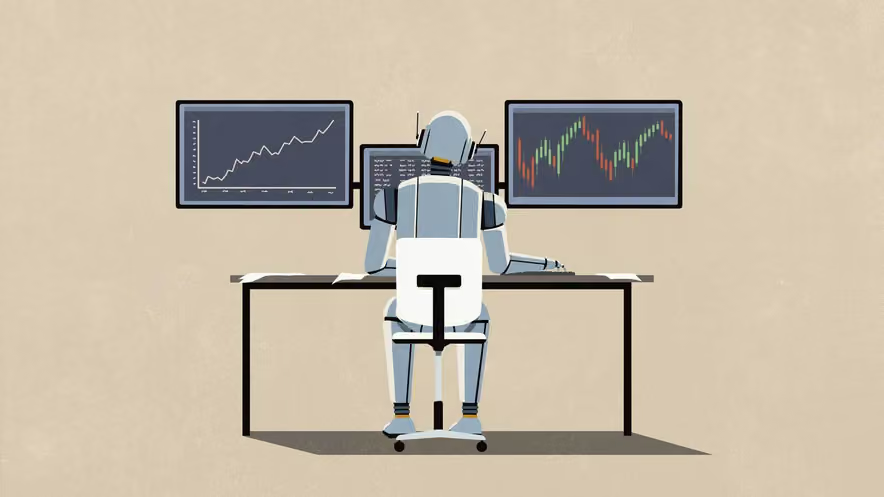
More than half of all requests come from a machine
The figure has the cold precision of bad news. Some 57.5% of requests to web pages come from automated systems, against 42.5% from people. Matthew Prince, Cloudflare's co-founder and CEO, shared it in early June from Cloudflare Radar, the public dashboard where the company publishes its traffic figures1. Since a large slice of the world's web traffic runs through Cloudflare's servers, which sit between sites and their visitors, the company is well placed to count who's knocking. Prince admits the data is "still rough, but the trend is unmistakable"2. So let's not quibble over the decimal, because for the first time in the history of the internet, most traffic is no longer human3.
Assistants that browse in our place
What tipped the scales has a name, agentic AI, the semi-autonomous programs that crawl the web on behalf of assistants like ChatGPT and Gemini. The math is merciless. Shopping for a camera, you might open five tabs before you commit, while an agent running the same errand hits thousands of pages in seconds and never breaks a sweat. Multiply that by the millions of people now handing their digital chores to a machine, and the traffic mix tips toward the bots on its own4.
The dizzying part isn't the crossover, it's the date. In March, on stage at SXSW, the same Matthew Prince put the tipping point at the end of 20275. He beat his own forecast by eighteen months, which, in an industry that usually errs by calling things too early, is genuinely staggering.
What the number leaves out
Before we declare the web emptied of humans, one honest caveat. Cloudflare counts requests, not presence or time spent, and the two are nothing alike. A reader who lingers ten minutes over an article fires off a handful of requests, while a bot fires thousands in the same span. By volume, the machines win in a landslide; by actual attention, people still hold a comfortable lead, busy scrolling their feeds, bingeing one more episode, and thumbing past the bottom of every page. We haven't been replaced, only outvoted by sheer headcount. The distinction matters, because the trouble isn't that humans left, it's that the web's plumbing now carries mostly something else.
A web that never planned for this
And that's exactly where it pinches, because the web was never built to run this way. Its whole economy rests on an unspoken bargain, where a publisher posts something for free, a human shows up to read it, sees an ad or subscribes, and the content gets paid for in the end4. A bot reads without clicking, burns bandwidth without buying anything, and, worse, scrapes whole pages to train models that will answer in your place tomorrow without ever pointing back to the source. The publisher foots the hosting bill, watches it swell with every machine visit, and gets next to nothing in return.
Cloudflare's CEO draws a blunt conclusion. For Matthew Prince, the future is "pay to crawl" for bots2. For the occasion the company has dusted off a forgotten corner of the HTTP protocol, the 402 "Payment Required" code, drafted back in the 1990s to bill for access and left idle for three decades for want of a use. It has now been promoted to tollbooth for the automated web, a status code that waited thirty years for a job. The open question is what becomes of a web where every page barricades itself behind a turnstile, where the humble robots.txt becomes a customs post, and where the original promise of a commons open to all hardens into an archipelago of fortresses charging admission. The "dead internet," that old fever dream of a web populated mostly by machines talking to machines, has never looked less far-fetched. By a different road, the question meets the one raised by an AI reclassified as a state secret. Who, exactly, owns what we put online?
I don't have a moral to pull from any of this, just a strange feeling. The sense of having crossed, without noticing, a line everyone placed much further out, and of crossing it with no visible sign at all, since the pages still load, the sites still run, and nothing looks any different. That may be the most unsettling part. For what it's worth, the very blog you're reading rolls out the welcome mat for these bots and openly invites them to index it6. So I'll leave you with the question I've been turning over for days. If the web fills up with visitors who aren't here to read, who are we writing for?
Notes
-
Cloudflare Radar, "Bot vs Human", real-time dashboard accessed June 2026. ↩ ↩2
-
The Decoder, "Cloudflare CEO says the web's future is 'pay to crawl' as bots overtake human traffic", June 2026. ↩ ↩2
-
NBC News, "Bot web traffic has overtaken human web traffic, data shows", June 2026. ↩
-
Forbes, Josipa Majic, "Bots Now Outnumber Humans Online, And The Internet Was Never Built For This", June 4, 2026. ↩ ↩2
-
TechCrunch, "Online bot traffic will exceed human traffic by 2027, Cloudflare CEO says", March 19, 2026. ↩
-
True to its word, this site's robots.txt explicitly welcomes indexing bots, AI included, and a /llms.txt even hands them a map. Might as well receive them politely. ↩