Soundcore Sleep, and finally sound asleep
soundcore Sleep earbuds put me under within the hour where it used to take three, after fifteen years of earplugs. The trick is sleight of hand, not silence.
Some fights you don't talk about much, because they happen in the dark and they usually end in defeat. Mine has a name every insomniac knows too well, hypervigilance, my brain's habit of standing guard right when the rest of me wants nothing more than to switch off. One scooter backfiring under my Paris windows, one neighbor slamming a door, and there I am, yanked back into the world with my ears on patrol. Add the charming reflex of replaying my entire day at the exact moment I should be letting it go, and you have the recipe for a night that never quite gets started.
For a long time I assumed silence was the only fix, and I was wrong. What follows isn't an ad. Nobody pays me to say nice things about it. It's just a report from a guy who sleeps badly and who, for once, found something that lived up to the box.
Fifteen years of half-measures
Before these earbuds, my whole arsenal fit inside a box of earplugs. For more than fifteen years I tried just about everything, the yellow foam you roll between your fingers and the wax you knead before pressing it over your ear, and each one came with a dealbreaker. The foam always let a thin trickle of noise through, just enough to wake a jumpy sleeper like me. The wax sealed better, but it traded that seal for greasy residue my ears would happily have done without come morning. Nobody warned me that signing up for silence also meant signing up for a daily cleanup.
None of it lasted, because none of it went after the real culprit. Plugging your ear canal solves the noise, but it leaves your brain alone with itself, which is a bit like locking the wolf and the lamb in one room and hoping for a quiet night.
How these earbuds smother the racket
Mine are the Sleep A20, two pairs I bought a few years back, when the line didn't yet have a fancier sibling1. Two, out of pure caution, one living permanently on my nightstand while the other rides in my suitcase, so I never crush my only pair at the bottom of a bag and condemn myself to some very long nights far from home. Since then soundcore, Anker's in-house brand, has rolled out the A30, which add genuine active noise cancellation and memory-foam tips, for a price that climbs to match2. My A20 settle for a simpler recipe, and it has been more than enough for me.
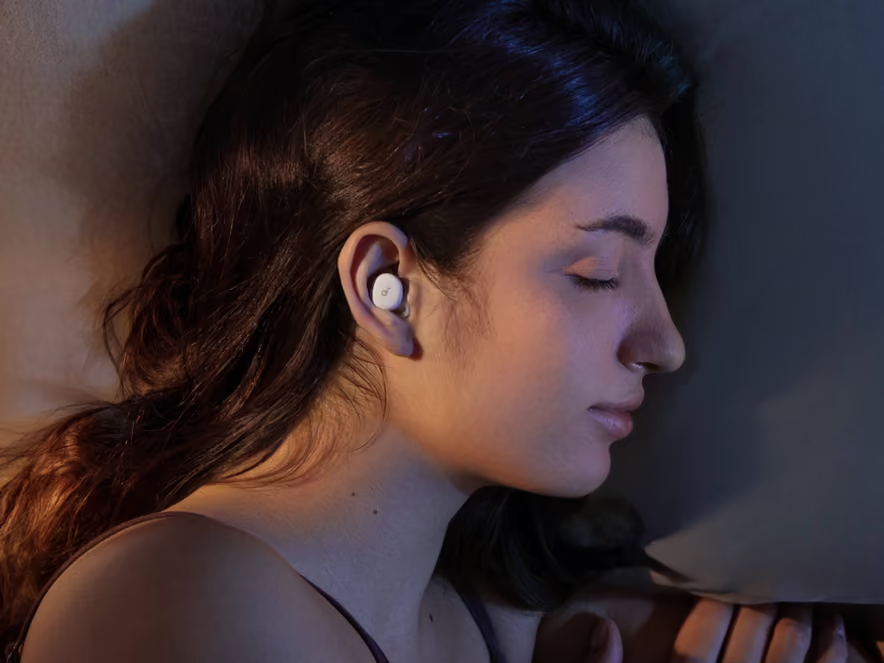
Because the trick isn't really about isolation, contrary to what you'd guess. The twin-seal tips already block part of the din, but the heavy lifting happens elsewhere, in the sound the earbuds pipe in continuously to paper over the rest, like white noise swallowing the night's rough edges3. The ear, busy with that soft blanket of sound, stops listening for the neighbor's scooter. All of it inside a flat little shell built so you can sleep on your side without driving a pebble into your ear canal, with enough charge for a full night and a few in reserve thanks to the case3.
The real magic trick, keeping my brain busy
The best part is left, and it owes less to engineering than to sleight of hand. Silence, oddly enough, never put me under, because it hands my ruminations an open stage. What I needed was something to occupy the part of my brain that refuses to clock out. The answer turns out to be whatever I slip into my ear, a good documentary, a long, meandering political interview, any program interesting enough to hold my attention without revving it up.
I drop the YouTube volume to its lowest notch, I follow the voice, and the mental carousel finally winds down. Most of the time I never learn how the documentary ends, because I'm out before it does. Sleep within the hour, near enough to a sure thing, where it used to take me three times as long to go under. If you're the type who counts sheep and never reaches the end of the flock, you get the picture.
One mishap, and one customer service desk
It wasn't all blissful, though. At one point an unfortunate firmware update turned my earbuds into shadows of themselves, the battery suddenly refusing to charge past ten percent. For devices meant to last the night, an hour of runtime counts as sabotage. As far as I know, Anker never managed to fix it with a later update, which, for a purely software fault, is a head-scratcher.
Where the story redeems itself is in what came next. I wrote to customer service, and they shipped me brand-new pairs without even asking for the old ones back, those having become fairly expensive paperweights anyway. That kind of gesture says more about a company than any spec sheet ever could, and it's probably why I've stuck with them.
What a pair of earbuds put back
I won't lie to you and promise a miracle. These earbuds didn't rebuild my nights from the ground up, because I still wake at three in the morning for no defensible reason. But where I used to lose the battle to fall back asleep before it began, my brain spinning up at the first flutter of an eyelid, I can now put a voice back in my ear and set off for another lap of sleep. That alone is a win I'd long since stopped expecting.
I doubt this blog will ever turn into a gadget aisle, since objects rarely interest me enough to earn a whole article. These are the exception, because they didn't add one more device to my life, they handed me back a little sleep. And when you've gone without it long enough, you know that's beyond price. If your nights look anything like mine, you now know where to look.
Notes
-
soundcore, the official Sleep Earbuds page, accessed June 2026. ↩
-
CNN Underscored, "Soundcore Sleep A30 earbuds review", for the active noise cancellation, memory-foam tips, and A30 pricing, accessed June 2026. ↩
-
SoundGuys, "Anker Soundcore Sleep A20 review", for the noise masking, twin-seal tips, and battery life, accessed June 2026. ↩ ↩2