Epic Games is done with hand-written code
Epic Games delayed its Marvel and Star Wars shooter and told the team to stop writing code by hand. Claude takes over. The delay came from planning, not typing.
Sometime in early October, on a video call, developers at Epic Games found out they would no longer be writing code. A project director then put it in writing, "no more hand-written code," and added that all art would be "generated with full AI workflows." According to the people Bloomberg talked to, the team was stunned. Then the jokes started, including one asking whether Claude would be the one fixing Claude's bugs1.
The game in question is the shooter the Fortnite studio is making with Disney, where Marvel heroes meet Star Wars. Bloomberg reported on October 12 that it will miss its March 2027 target and that the team has been given no new date. The team now has to build it "AI-first," with Anthropic's Claude doing the work and developers guiding and reviewing what the model writes1. The same day, Epic CEO Tim Sweeney confirmed on X that the whole company has "a huge pivot underway," with developers moved around "to retool for maximum AI acceleration"2.
The keyboard wasn't the problem
The most telling detail in the report is the reason for the delay. Bloomberg's sources don't blame the engine or the tech. They say Epic underestimated how much time and how many people the game needed1. For a project manager, that's about the most ordinary diagnosis there is, the one you could hand to half the late projects on earth. The usual fixes come in three flavors: cut what ships at launch, move the date, or hire. Epic moved the date and swapped the hiring for Claude.
The backstory makes that choice less surprising. On March 24, Epic laid off more than 1,000 people, about 20% of its staff, with Sweeney explaining that the slump in Fortnite engagement since 2025 meant the company was "spending significantly more than we're making"3. Epic said at the time that the cuts had nothing to do with AI. Seven months later, a project is short on people and the answer comes as a subscription. Sweeney insists the aim "isn't to do the same stuff with fewer people, but to enable everyone here to build MORE and BETTER stuff"2. The capitals are his.
What Brooks's law says about reinforcements
In 1975, Fred Brooks, who had run the development of an operating system at IBM, turned his scars into a rule every project manager eventually learns the hard way. Adding people to a late software project makes it later4. Newcomers have to be trained by the people who already know the code, and every extra person multiplies the conversations it takes to keep everyone on the same page. So Epic wouldn't have gained much from a hiring spree, which may be the best argument for its bet.
Claude doesn't get an exemption from the law, though. An agent5 learns a project the way any new hire does, from whatever it's told, and every line it writes has to be reviewed by someone who knows the game. Epic's directive moves developers from writing to reviewing, and reviewing is the part the coverage skips. A model writes faster than a person, but a person reviews more slowly than a model writes. The bottleneck didn't go away. It just moved desks.
Sweeney is right about prototypes
In replies on X, reported by Inven Global, Sweeney made his best case. The biggest change, he said, is how much shorter the gap gets between an idea and something you can play. He added that many recent big-budget failures came from systems nobody could playtest for most of development6. He's right, and I'm in no position to argue. I've written here about having Claude build prototypes that future users click through before a spec even exists, because a screen that responds gets people talking far better than a hundred-page document.
I almost never read the code behind those prototypes, though, and I can get away with it for exactly one reason. They never go to production, and nobody will ever reuse that code as is. The day someone tells me "it works, ship it," the answer is no. Epic's directive erases precisely that line, since it isn't aimed at a mock-up of one level but at a game that will be sold to millions of players, servers and potential security holes included. Testing an idea in an afternoon and shipping a game without a single hand-written line are two different jobs, and Sweeney is using the first to justify the second.
Who answers for the code
That leaves a question the directive skips, which is accountability. On any project, someone answers for every release. When the code comes from Claude and the review happens under the pressure of a delay that's already public, that person is signing off on work they didn't do, at a pace they didn't pick. Epic communications director Jake Jones says the company is "embracing AI-accelerated development, led by Epic developers"1. It's a nice line. It doesn't say who reviews.
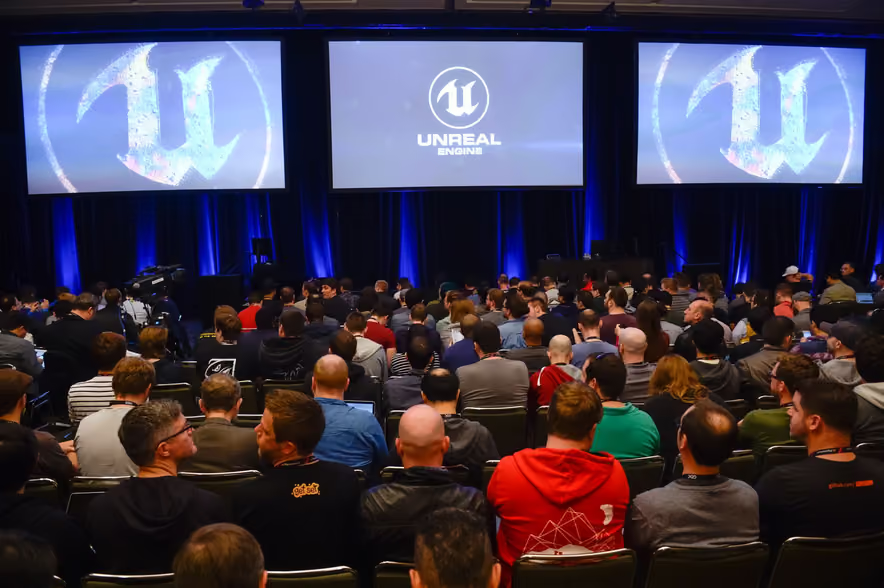
The story goes beyond one delayed game, because Epic isn't just another studio. It makes Unreal Engine, the software foundation behind a large share of games and a growing number of film and TV shoots, and Sweeney wants the benefits of his pivot to reach "all teams using Unreal"2. Krafton, the PUBG publisher, declared itself "AI-first" a year ago, and Square Enix wants generative AI to handle 70% of its QA and debugging by the end of 20276. At gamescom, 30% of the industry speakers surveyed wanted as little AI as possible in how their games get made. At Epic, that debate is over.
I use Claude every day and have no desire to go back. That's exactly why the directive puzzles me. A tool that writes fast needs someone who knows when to say no, and Epic just told its developers they'd stop writing without telling them how much time they'll get to push back. When the game finally ships, it will say less about Claude than about that time.
Notes
-
Reported by Jason Schreier for Bloomberg on October 12, 2026, as relayed by Insider Gaming and by Presse-citron (in French). Epic has confirmed only its shift toward AI, not the reason for the delay or the exact wording of the directive. ↩ ↩2 ↩3 ↩4
-
Tim Sweeney's post on X, October 12, 2026, quoted by Insider Gaming. ↩ ↩2 ↩3
-
PBS NewsHour, citing the memo Tim Sweeney sent staff on March 24, 2026. Epic had about 4,000 employees after the cuts. ↩
-
Frederick Brooks, The Mythical Man-Month, 1975, drawing on his time leading IBM's OS/360 project. The rule is summarized on Wikipedia, and Brooks himself called it "outrageously oversimplified," which hasn't stopped it from coming true somewhere every week. ↩
-
An agent is a language model installed in your working environment that can read and write files and run commands, whereas a chat assistant just answers in a window. ↩
-
Inven Global, "Epic delays Disney shooter amid shift to AI-first model", October 12, 2026, which also reports the joke about Claude fixing Claude. ↩ ↩2