The Wave or how to build a dictatorship in five days
The Wave (2008) shows a classroom sliding into dictatorship in five days. The film copies a real 1967 experiment, and 2026 looks a little too much like it.
It all started with lunch with a friend, somewhere between a bò bún and a round of good yakitori. You know how it goes. Lunch runs long and the conversation wanders wherever it likes. That day it wandered into social experiments. One thing led to another and I remembered a film that had stuck with me since it came out, The Wave, along with a question harder to digest than the meal. Why does a 2008 movie read so much like the 2026 news?
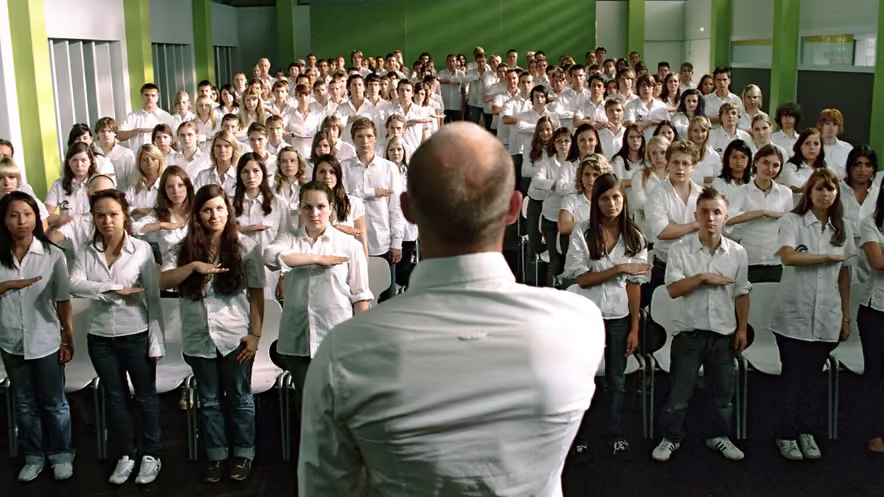
One week of class and everything tips over
The Wave (Die Welle in the original German), directed by Dennis Gansel, follows Rainer Wenger, a laid-back high school teacher played by Jürgen Vogel, who gets stuck running a project week on autocracy1. His students couldn't be less interested. A dictatorship could never happen in Germany again, they've learned that lesson. So he tries a hands-on demo. Some discipline, white shirts for everyone, a salute, a name to rally around, and there it is, the Wave, a classroom movement that quickly stops being a classroom movement.
What got me is how ordinary the levers are. Nobody wakes up dreaming of fascism. Each kid just finds something in the group they were missing, belonging for one, payback for another, a substitute family for the most fragile. The trap closes over five days of class. I'll stop there so I don't spoil it, except to say the film follows its logic all the way down, and the last scene is no prom. German audiences showed up, with 2.5 million tickets sold and a German Film Award to show for it1.
The real Third Wave
The uncomfortable part is how little Gansel had to make up. In April 1967, at Cubberley High School in Palo Alto, history teacher Ron Jones got stumped by a student. How could ordinary Germans have let it happen? He decided to answer in practice2.
Monday, discipline ("strength through discipline"). Tuesday, community, a name, the Third Wave, and a salute. Wednesday, membership cards, and a class of thirty swelled past two hundred volunteers from all over the school. Thursday, Jones announced a national movement, with its presidential candidate to be revealed the next day.
On Friday, the assembled students stared at a blank TV screen, then watched a documentary about the Third Reich. Five days, the same span the film would borrow four decades later, by way of Todd Strasser's 1981 novel that made the story famous2. Now, you could point out that a classroom isn't a scientific protocol, and you'd be right. Which is exactly why other people took the question into the lab.
Three experiments that should keep you up at night
On conformity, Solomon Asch showed back in 1951 that you don't even need uniforms. The task was dead simple, comparing line lengths. Tested alone, people got it wrong less than 1% of the time. Seated among plants who confidently gave the wrong answer, 74% of them went against their own eyes at least once3. I'm not sure I would have held out.
On obedience, Stanley Milgram set up his famous fake-shock machine at Yale in 1961. Sixty-five percent of participants agreed to deliver the maximum 450-volt jolt to a stranger because a man in a lab coat told them to4. Gina Perry's digging in the archives has since complicated the picture, since a share of participants doubted the setup was real. Less spectacular, sure. Still not exactly comforting4.
Then there's the famous 1971 Stanford prison experiment, guards versus prisoners drawn by lot, which is worth mentioning as much for itself as for its takedown. French researcher Thibault Le Texier went through the archives and showed that the guards had been coached on how to behave and that the conclusions were more or less written in advance5. So the lesson cuts both ways. We bend to the roles we're handed, and we love a story that fits too neatly, even when a university professor signs it.
When a myth dresses up as science
That same appetite for a good story also produces fake experiments, beliefs that travel with the confidence of established fact and no solid data behind them. Period syncing is the textbook case, and I'll plead guilty, because I served it to my friend that afternoon as settled truth before I bothered to check. The idea goes back to a 1971 study by Martha McClintock in Nature, which claimed that women living together end up with aligned cycles. Except that cycles of roughly twenty-eight days, each lasting about five, will overlap now and then by pure chance. Later reanalyses flagged the original study's methodological errors, and no serious research has confirmed the effect6.
Human pheromones, another topic from that lunch, belong on the same shelf. Perfumes promise to switch on attraction, and people love to cite Claus Wedekind's t-shirt study, where women preferred the smell of men whose immune systems complemented their own. The result doesn't replicate well, and the organ that's supposed to pick up these signals is vestigial in humans. To this day, no human pheromone has been formally identified, as zoologist Tristram Wyatt keeps pointing out after years of chasing the molecules sold to us as such7. Social experiments tell us a lot, even when they never happened. If you've got a fascinating one up your sleeve, real or mythical, my inbox is wide open.
Where to watch The Wave
In the US, The Wave is available to rent or buy on Amazon Video8, and it turns up in Apple TV's catalog too. Streaming lineups shift constantly, so a quick stop at JustWatch will tell you where it is today.
Sixty years after Palo Alto, democracies we thought were anchored for good are sliding toward authoritarianism in plain sight. The mechanisms are the ones this high school movie was already taking apart, the need to belong, the comfort of discipline, the handy scapegoat. The lessons of the past are holding up worse than we hoped. A hundred and seven minutes of The Wave won't fix that, but they're a good reminder of how gentle the slope feels, and of how much company you have on the way down.
Notes
-
The day-by-day account of Ron Jones's experiment is documented on Wikipedia, along with Todd Strasser's novel The Wave that made the story famous. ↩ ↩2
-
The Asch conformity experiments, run from 1951 at Swarthmore College. ↩
-
The Milgram experiment, including Gina Perry's criticism based on her work in the Yale archives. ↩ ↩2
-
The Stanford prison experiment and Thibault Le Texier, Histoire d'un mensonge. Enquête sur l'expérience de Stanford (in French), La Découverte, 2018. ↩
-
Quebec's Chief Scientist, "Des menstruations synchronisées ? Probablement pas" (in French). ↩
-
Green Condom Club's feature on pheromones and attraction (in French); on the absence of any formally identified human pheromone, see Tristram Wyatt, The search for human pheromones, Proceedings of the Royal Society B, 2015. ↩
-
The Wave (Die Welle) on Amazon, digital rental and purchase. Yes, I checked streaming availability for a movie about conformity. Everybody else was doing it. ↩