Midjourney dreams of an MRI at spa speed
Midjourney announces a sixty-second ultrasonic body scanner, opening inside a San Francisco spa in late 2027. The engineering is real, the diagnosis isn't.
I read the announcement twice to make sure it wasn't, fittingly, a generated image. Midjourney, the image generator everyone associates with too-smooth portraits and impossible landscapes, is getting into medical imaging. Not by drawing X-rays, either. With an actual machine that claims to map the inside of your body in a minute, when a full MRI often takes more than an hour1. The company dreams of something "as powerful as MRI, and as casual as a trip to the spa"2. Some career changes really make you blink.
An image generator that comes for yours
None of it actually involves image generation. You step onto a platform that slowly sinks into a shallow pool. It carries you through a ring of sensors that probe your body a bit like a dolphin figures out its surroundings by listening to its own echoes2. There are half a million of them, each the size of a grain of sand, each a tiny speaker and a tiny microphone in turn. They hit your body with sound waves from every angle, and all those echoes get assembled into a map of what's going on inside. No radiation, no giant magnet, about sixty seconds2.
The chips come from Butterfly Network, a maker of pocket ultrasound devices that Midjourney has backed with more than $74 million3. The stated goal is 50,000 machines around the world by 20314. Founder David Holz isn't big on caution. He calls the machine "in many ways superior to even MRI machines"5. The announcement itself claims that with enough early imaging, the world could "avoid 30% of all deaths and 50% of all healthcare costs"2. Nothing too ambitious, then.
The spa that wants to be a hospital
This is where it gets genuinely weird. The first machine won't open in a hospital but in a "Midjourney Spa," due in late 2027 near Union Square in San Francisco. Nine or ten scanners will sit alongside saunas, hot tubs, and cold plunges5. The company talks up "pools of golden light" washing over you, and calls the scan itself a mere "side-effect" of relaxing2. You stop knowing whether you're buying a checkup or a spa day. Finding a tumor between two sauna sessions, can you picture it?
An MRI with no AI, and not quite an MRI
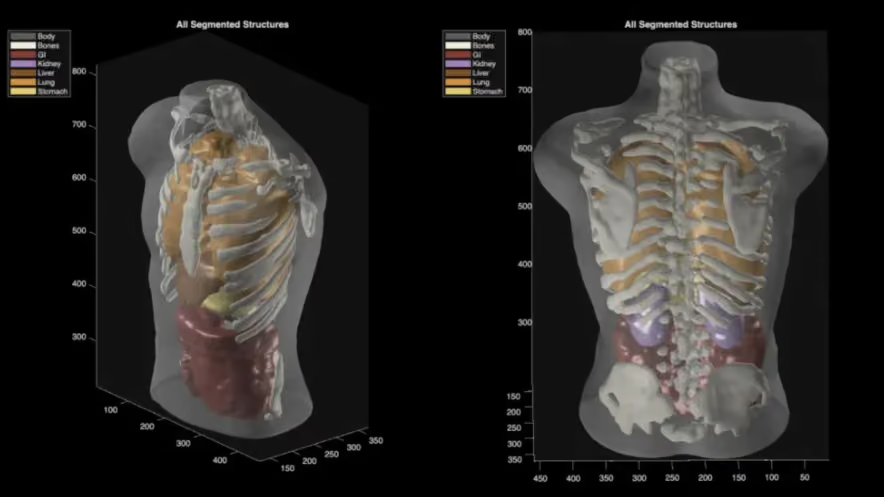
Then there's the touchy part, hallucinations, those confident mistakes an AI makes up and that everyone dreads the moment it gets near a diagnosis. Ironically, the scanner barely uses any AI. Holz says so himself, "we're not even using any AI in this yet, just really cool hardware and software"5. For now, the machine learning just traces and labels organs on the image, which is exactly what the screenshot above shows2. So no imaginary lesions to worry about, as long as diagnosis stays off the table.
The real problem is elsewhere. First, "full-body" sounds great but misleads, since ultrasound can't get through the skull and will never see the brain the way an MRI does5. Second, scanning healthy people on a conveyor belt is something medicine has frowned on for a long time. It piles up false positives, anomalies that turn out to be nothing, and incidental findings that send you off for stressful, sometimes invasive, usually pointless follow-ups5. For now, this prototype only produces body-composition maps. It still has to win over the FDA, the US drug and medical device regulator, before it can claim to diagnose anything2.
I'm torn, and I think that's fair. The engineering is real, and trading an hour in a loud, pricey MRI for a minute in warm water, who'd say no? Except that between a filmed demo and a device radiologists will trust lies a gap that neither "golden light" nor superlatives can fill. We've already seen AI get a standing ovation for a splashy announcement long before any product existed. Until the regulators weigh in, what sticks with me is the picture of a company that makes synthetic dreams now wanting to show us, for real, what's going on inside us. Whether we actually want to see it is another question.
Notes
-
Engadget, "Midjourney, the AI image generator, is developing a full-body ultrasonic scanner", June 2026. ↩
-
Midjourney, "A New Era of Midjourney", the official Midjourney Medical announcement, June 2026. ↩ ↩2 ↩3 ↩4 ↩5 ↩6 ↩7
-
Radiology Business, "AI lab Midjourney investing over $74M to launch whole-body ultrasound screening business", June 2026. ↩
-
The announcement also aims for a billion scans a month. To give you an idea, that would run every human on Earth through the machine roughly once every eight months. The spa is going to need a lot of towels. ↩
-
The Next Web, "Midjourney's full-body scanner, big claims, no track record", June 2026. The spa would cover about 25,000 square feet. ↩ ↩2 ↩3 ↩4 ↩5